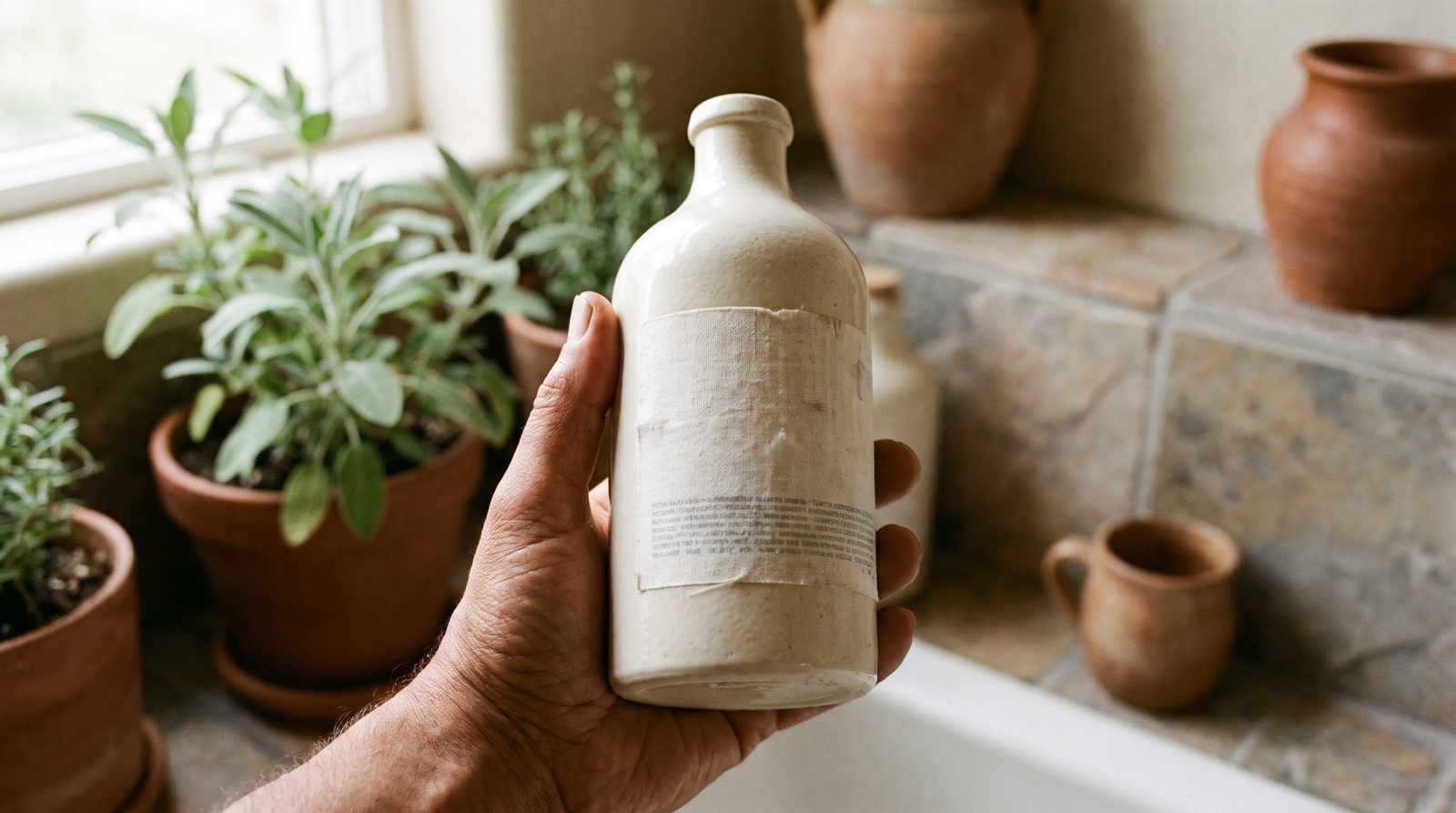
The ingredient list on the back of a bottle is the most useful thing on the pack. It is regulated, it follows a fixed set of rules, and once you know those rules you can tell a lot about a product in a minute or so. You cannot tell everything, and the limits are worth knowing.
The names: INCI
Cosmetic ingredient lists in the UK use INCI names, short for International Nomenclature of Cosmetic Ingredients. The point of INCI is that the same ingredient has the same name on every product in every country that uses it, whatever language the rest of the label is in.
A few conventions help with reading them:
- Water is usually listed as Aqua, sometimes as Water/Aqua.
- Plant ingredients use the Latin botanical name, often with the common name in brackets and the part of the plant used, for example Avena Sativa (Oat) Kernel Extract or Butyrospermum Parkii (Shea) Butter.
- Most other ingredients use a standard chemical name in English, such as Sodium Cocoyl Isethionate or Cetearyl Alcohol.
- Colourants are listed by their Colour Index number, which looks like CI 77491.
- Fragrance blends appear as Parfum.
The names can look alarming, but most are just precise. Tocopherol is vitamin E. Sodium Chloride is table salt. Butyrospermum Parkii Butter is shea butter.
The order, and the 1% line
Ingredients are listed in descending order of weight at the time they were added to the formula. The first ingredient is the one there is most of, usually water in a shampoo or conditioner. The second is the next largest, and so on.
The rule changes at 1%. Ingredients present at less than 1% can be listed in any order after the ones above 1%. A brand can put a botanical extract at 0.1% above a preservative at 0.8%, and both labels would be correct.
This is the most important thing to understand about an ingredient list. The headline ingredient on the front of the pack, the oil or extract the product is named after, is very often below the 1% line. That does not automatically mean it does nothing, since some ingredients work at low levels, but it does mean you cannot tell how much is in there from the list alone.
Finding the 1% line
You cannot see it directly, but there are clues. Some ingredients have a legal maximum of 1% or less in cosmetics, so anything listed after them must also be at 1% or below. Phenoxyethanol, a very common preservative, is capped at 1%. Fragrance allergens, colourants and most preservatives are almost always below 1%. If an ingredient you care about appears after any of these, it is present at a low level.
What the first five tell you
In a typical rinse-off product, the first four or five ingredients make up most of the formula. They tell you what kind of product it really is.
- In a shampoo, look for the surfactants, the ingredients that do the cleaning. Sodium Lauryl Sulfate is effective but can feel stripping on some scalps. Sodium Laureth Sulfate is a milder relative. Isethionates, glutamates and glucosides are generally milder still.
- In a conditioner, look for conditioning agents such as Behentrimonium Chloride, and fatty alcohols such as Cetearyl Alcohol. These are what make hair feel softer and easier to comb.
- In an oil or serum, the first ingredient tells you whether it is mostly oil, mostly silicone, or mostly water.
Alcohols are not all the same
Fatty alcohols, such as Cetyl Alcohol, Stearyl Alcohol and Cetearyl Alcohol, are waxy solids that soften hair and thicken creams. They are not drying. The alcohol people usually mean when they worry about drying is Alcohol Denat., the volatile kind that evaporates quickly. It is used in some sprays to help them dry fast. High up the list in a leave-on product, it can feel drying on hair that is already dry.
Fragrance and fragrance allergens
A fragrance can contain dozens of individual materials, and the law allows them to be grouped under the single word Parfum. There is one important exception. A set of fragrance ingredients known to cause allergic reactions in some people has to be named individually in the list if the product contains more than 0.01% of it in a rinse-off product, or more than 0.001% in a leave-on product.
These are the names that often appear near the end of a list: Limonene, Linalool, Citronellol, Geraniol, Coumarin, Citral and others. The EU expanded its list of named allergens in 2023 to more than 80, and products made for both markets may follow the longer list.
Two things are worth knowing:
- These allergens are not only found in synthetic fragrance. Essential oils contain them too. Lavender oil contains linalool, for example, and citrus oils contain limonene. A product described as “fragranced only with essential oils” will still list them.
- If you have been diagnosed with a fragrance allergy, ask your dermatologist which specific substances to avoid, and check for those names. Avoiding the word Parfum on its own is not enough.
“Fragrance-free” and “unscented” have no legal definition. An unscented product can contain a masking fragrance to cover the smell of the base. The ingredient list is the only reliable guide.
What “silicone-free” does and does not mean
Silicones are ingredients that form a smooth, slippery film on hair. They reduce friction when you comb, help with frizz and add shine. On an ingredient list, most end in -cone or -siloxane: Dimethicone, Amodimethicone, Cyclopentasiloxane.
A “silicone-free” product simply contains none of these. That can be a reasonable preference. Some heavier silicones build up on fine hair, and some people prefer the feel without them.
What silicone-free does not mean:
- It does not mean the product will not coat your hair. Oils, butters, waxes and conditioning polymers (which often appear as Polyquaternium followed by a number) also form films, and they can build up too.
- It does not mean the product is gentler or safer. Silicones used in hair care are assessed for safety like any other ingredient.
The same caution applies to most “free from” labels. They tell you what is absent, not what the product is like.
What the list cannot tell you
An ingredient list does not give you percentages, except where a brand chooses to state them. It does not tell you the quality of an ingredient, how well a formula is put together, or whether it will suit your hair.
It also cannot tell you whether a product is safe for you in particular. Every cosmetic sold in Great Britain must have a safety assessment, but sensitivity varies between people. If you react to something, note the full list and compare it with other products that have caused problems. The ingredient they share is often the culprit.
Finally, formulas change. Brands reformulate when an ingredient becomes unavailable or the rules change. The list printed on the pack in your hand is the one that applies.
A quick routine for reading a label
- Read the first five ingredients to see what the product mostly is.
- Find the preservative or the first fragrance allergen to estimate the 1% line.
- Check where the headline ingredient sits relative to that line.
- Look for anything you know you react to.
- If a brand states a percentage, note it. If it does not, you have to judge from the order.
How we label ours
We list every product’s full ingredients on its page in standard INCI form, and we give the percentage of the main active where we can, so you do not have to guess from the order. You could try the routine above on Daily Shampoo or Leave-In Milk. If anything on one of our labels is unclear, email us and we will explain it.
This article is general information about hair and scalp care, not medical advice. If your scalp is sore, bleeding, or not improving after a few weeks, see a GP or a pharmacist.